Helping women over 40 reclaim their health
Eat Real Food—But Let’s Make It Make Sense
A Practical, Personalized Take on the New Dietary Guidelines
Table of Contents
What the New Dietary Guidelines Get Right
Why the Food Pyramid Still Creates Confusion
A More Practical Way to Think About Food
The Model I use with my Clients
The new Dietary Guidelines for Americans emphasize eating real food—and that’s a welcome change. But for many women, especially in midlife, the question remains:
How do I actually apply this to my meals?
The new Dietary Guidelines for Americans (2025–2030) emphasize eating real food—a shift I strongly support. They encourage whole foods and a move away from ultra-processed options, added sugars, and refined carbohydrates.
That’s a step in the right direction.
But broad guidelines don’t always translate easily into real life.
For many women, the challenge isn’t knowing what foods are “healthy”—it’s understanding how to build meals in a way that actually works for their body.
Let’s talk about that.
What the New Dietary Guidelines Get Right
Before offering critique, it’s important to acknowledge what these updated guidelines do well.
They:
Emphasize whole, minimally processed foods
Call for a reduction in ultra-processed foods and added sugars
Recognize the role of nutrition in preventing chronic disease
Highlight the importance of protein, fiber, hydration, and movement
This represents a real important and needed shift away from decades of low-quality dietary advice. It’s a better foundation than we’ve had in a long time.
But a foundation still needs a structure people can actually use.
Why the Food Pyramid Still Creates Confusion
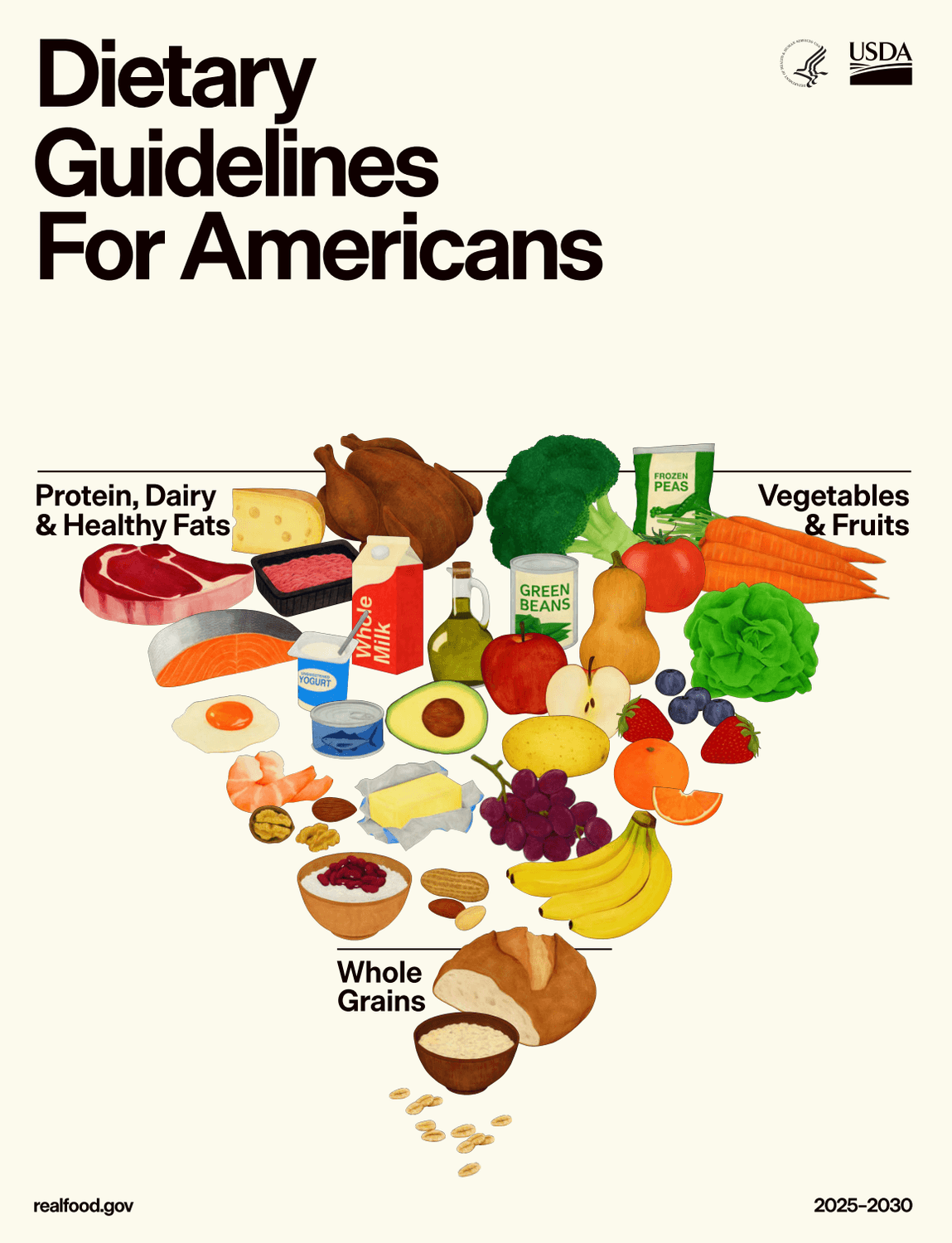
The Dietary Guidelines for Americans food pyramid, designed to communicate nutrition priorities.
The food pyramid has been used for decades to visually represent nutrition guidance. Earlier versions were heavily influenced by low-fat dietary advice, placing grains and carbohydrates at the base while minimizing protein and fat. Over time, it became clear that this approach didn’t support blood sugar balance, satiety, or metabolic health for many people.
To be fair, nutrition guidance has evolved. There has been a steady shift toward better food quality, fewer ultra-processed foods, and more emphasis on whole, nutrient-dense options. The original pyramid was eventually retired, and simpler models—like the Healthy Plate—were introduced to make guidance easier to apply.
However, the current pyramid model has reintroduced confusion. Balanced on a narrow point, it doesn’t reflect how people actually eat or how the body works. Visually, it feels unstable, and practically, it offers little help with day-to-day decision-making.
For many women, especially in midlife, this leads to:
Overthinking meals
Forcing foods that don’t feel good
Confusion around portions and priorities
Most importantly, people don’t eat pyramids.
They eat plates.
When a visual model creates more confusion than clarity, it stops being useful.
A More Practical Way to Think About Food
Based on my education and years of working with women, I’ve found that nutrition guidance works best when it reflects how the body actually works and real-life eating—not just food categories on paper.
Before getting to how I coach day to day, it helps to clarify priorities.
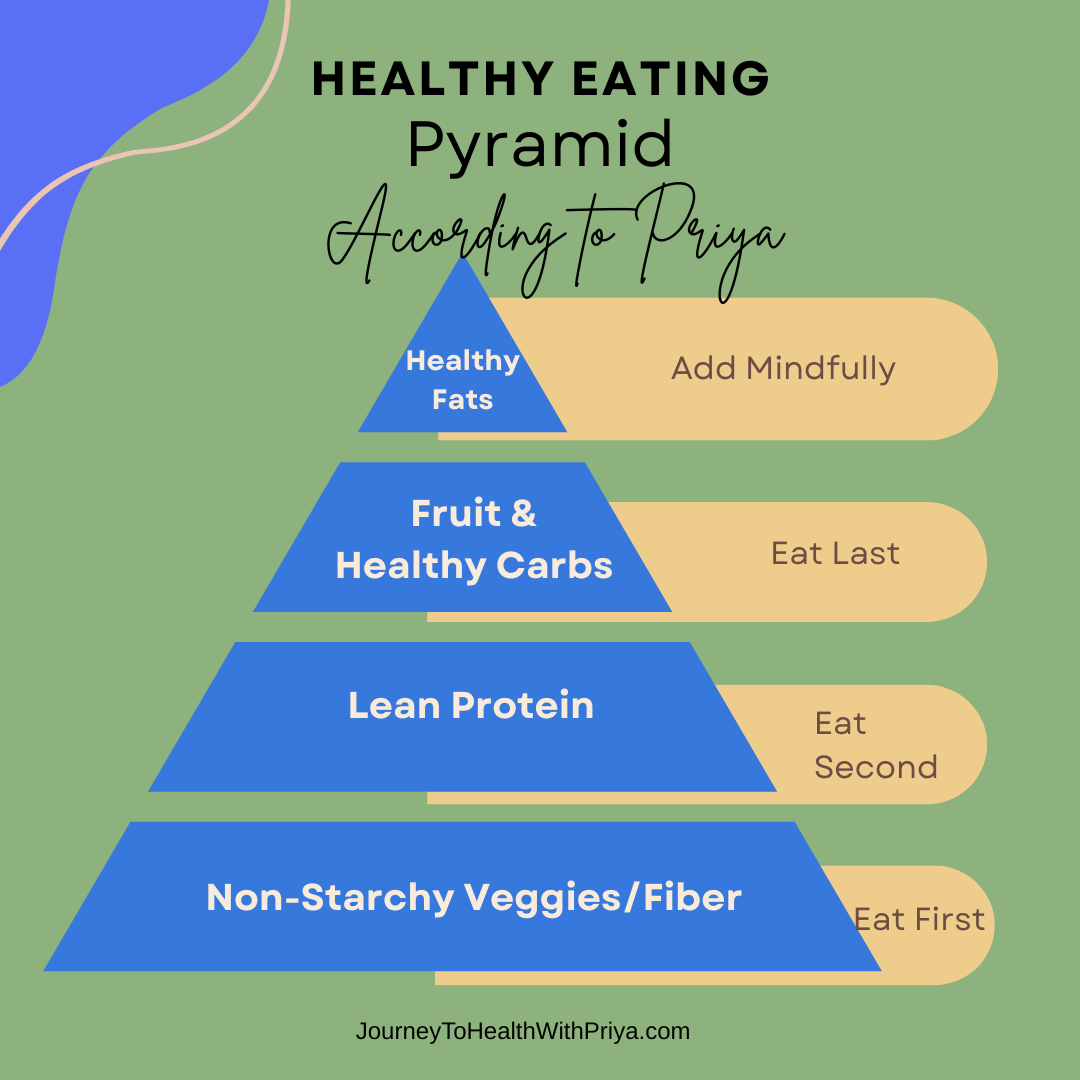
A simplified food-priority pyramid showing sequence and emphasis: vegetables first, protein second, carbohydrates next, fats added mindfully
Above is my modification of the Food Pyramid.
This pyramid is not meant to be followed rigidly, of course. It’s a conceptual framework—not a set of rules.
I have added in the order of eating these 'macros', to help with blood sugar control and prevent overeating, especially for those wanting to lose body fat.
It reflects what most meals are best built around:
Non-starchy vegetables and fiber as the foundation, and what you should start with.
Lean protein to support muscle, metabolism, and satiety. You eat this second.
Healthy carbohydrates and fruit as supportive options, adjusted based on individual needs and tolerance. You eat this last.
Healthy fats used mindfully for cooking and flavor
This framework allows for personalization.
Grains, fruit, and dairy are not universally tolerated or required, and this model leaves room for individual response.
But when it comes to actual eating…
I Don’t Coach With a Pyramid—I Coach With a Plate
When it comes to how I help women eat in real life, I don’t use a pyramid.
I use a plate.
Because meals are eaten one at a time—not in 'theory'.
As you may see below, I have recommended using 'Fruit and Healthy Carbs' as an alternative to 'Grain/Starch'.
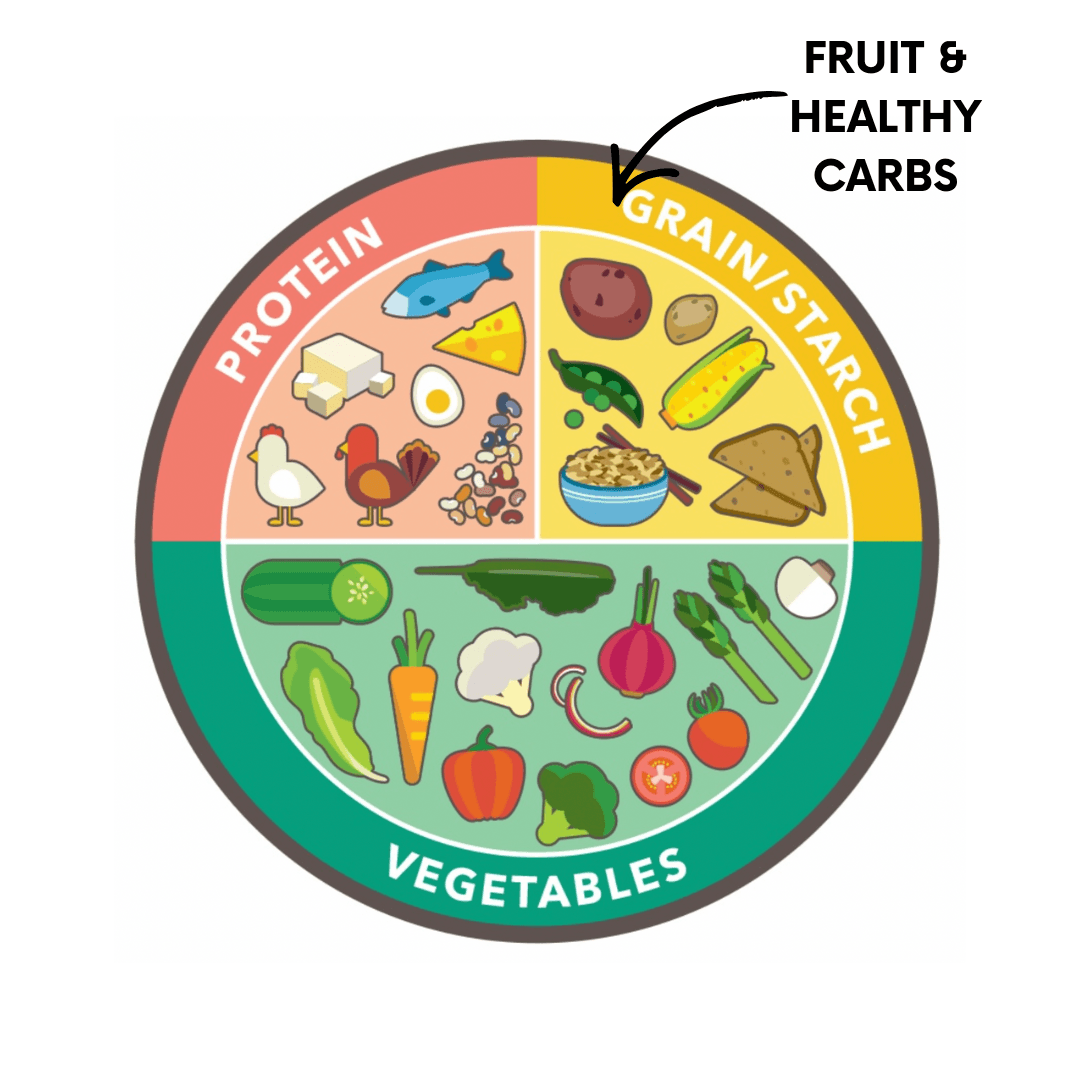
A simple, flexible plate model for building balanced meals without tracking, measuring, or perfection.
How to Use This Plate
This is the model I use with clients because it is visual, intuitive, and adaptable.
½ plate: non-starchy vegetables
¼ plate: lean protein
¼ plate: healthy carbohydrates
(starchy vegetables, whole grains, or fruit—based on tolerance and needs)Plus: a small amount of healthy fat for cooking or dressing
Portions can change based on activity level, digestion, blood sugar response, and individual goals. There is no single “perfect” plate.
Eating in this way consistently matters more than precision.
The Bottom Line
The new Dietary Guidelines for Americans move us in a better direction—but they are a starting point, not a prescription.
Real health doesn’t come from forcing foods because they’re labeled 'healthy'. It comes from learning how to build meals that support your body, your energy, and your life.
Simple, clear guidelines make healthy habits easier to sustain.
And sustainability is what actually changes health.
If you’re unsure how to personalize this plate for your digestion, blood sugar, or goals, that’s where coaching can help. This is exactly the work I do with women—turning guidance into simple habits that fit real life.
If you liked this post, leave a comment and share with someone who needs to read it.
Also, check out my post The #1 nutrition principle for women in peri-menopause/menopause.
Sources:
2025-2030 Dietary Guidelines for Americans
“Journey to Health with Priya” provides general educational information on various topics on this website as a public service, which should not be construed as professional medical advice nor be used as a substitute for direct medical advice from your doctor or other qualified clinician.
Sign up for your Total Health Audit
Want to maintain the look & feel of being young?
Low energy? Stubborn weight?
Sign up for the Free course