
Helping women over 40 reclaim their health & age strong
Soleus Pushups: The 5-Minute Movement That Stabilizes Blood Sugar (Without Leaving Your Chair)
You know you should move after eating. A walk after lunch would stabilize your blood sugar, boost energy, reduce cravings. But you're at work. In meetings. Having lunch with friends. You can't just get up and leave.
So you don't move. Your blood sugar spikes. By 3pm, you're exhausted and reaching for something sweet.
Here's what I see: movement after meals matters. But it doesn't always have to be a walk.
There's a seated micro-movement that works just as well—and nobody will even know you're doing it.
What Is a Soleus Pushup?
(It's Simpler Than You Think)
Despite the name, there's no floor. No sweating. No gym required.
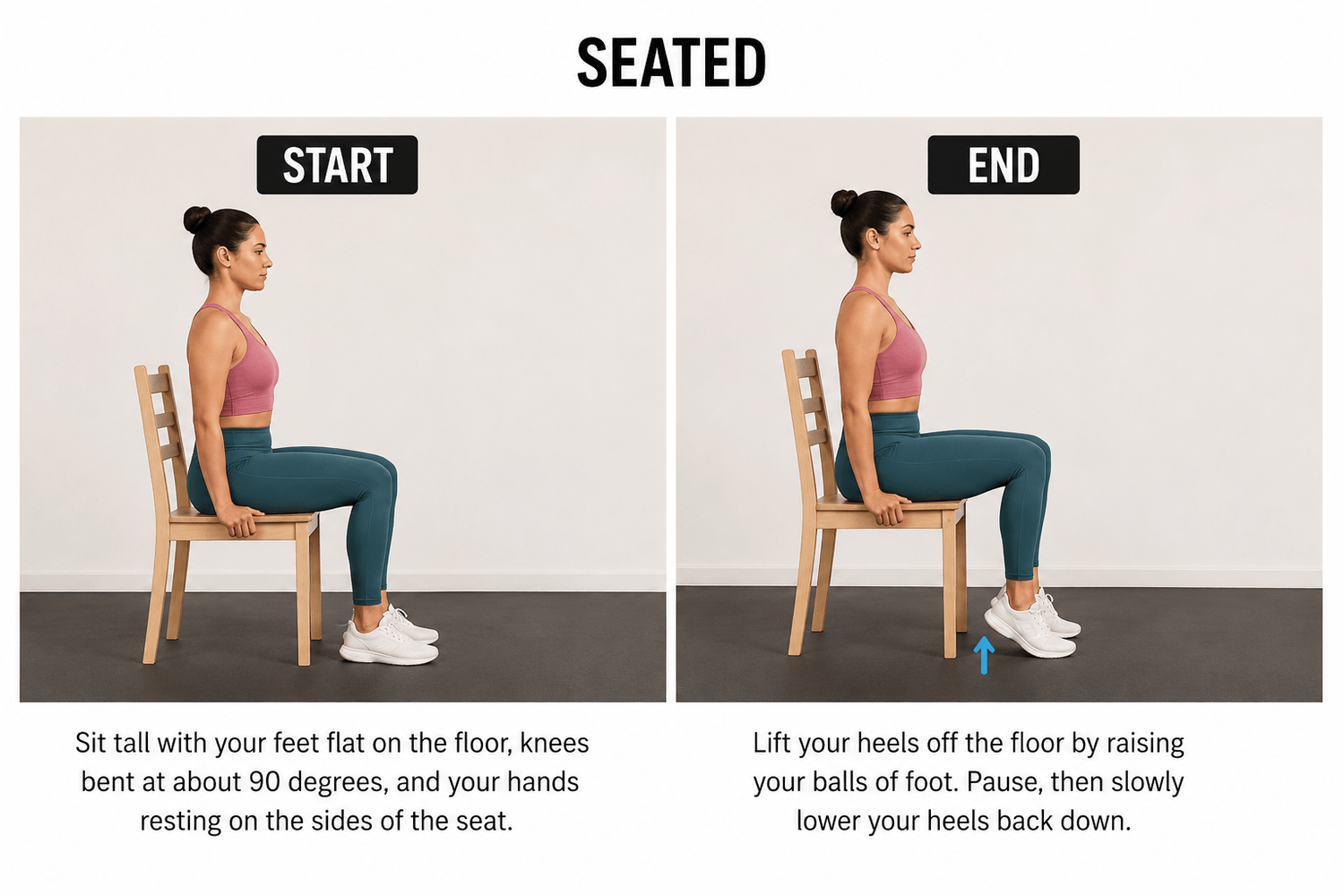
A soleus pushup is a seated heel raise. You sit with your feet flat on the floor. You lift your heels up and down while your toes stay planted. That's it.
The movement is so small and discreet that you can do it while:
Sitting through a work meeting
During a lunch break (nobody will notice)
While watching TV
While on a phone call
During your commute
But don't let the simplicity fool you. This tiny movement activates one of your body's most metabolically powerful muscles: the soleus.
Why the Soleus Muscle Matters
Your calf has multiple muscles. Most people know about the gastrocnemius (the big, visible calf muscle). But underneath it is the soleus—a smaller muscle with extraordinary metabolic properties.
Here's what makes the soleus unique:
Unlike other skeletal muscles that rely heavily on glycogen for energy, the soleus has a different strategy. It preferentially burns blood glucose and circulating fats as its primary fuel sources.
This means when you contract the soleus muscle, it acts like a glucose vacuum cleaner. It pulls glucose directly from your bloodstream and into the muscle, without needing insulin to do it. This is called a non-insulin-dependent glucose uptake mechanism.
For someone trying to manage blood sugar, reduce cravings, and stabilize energy—this is game-changing.
The Science: What Research Actually Shows
You've probably heard a lot of health claims. So let me be direct: the research on soleus pushups is solid.
Post-Meal Blood Sugar Control
Studies show that performing soleus pushups after meals results in approximately a 32-50% reduction in blood sugar spikes. This happens because the soleus muscle is pulling glucose out of your bloodstream and storing it as energy in the muscle, rather than letting it spike into your blood.
This is especially important because high blood sugar spikes trigger insulin release, increase inflammation, and contribute to energy crashes, cravings, and weight gain.
Fat Metabolism and Triglyceride Reduction
It's not just about glucose. Soleus activation also enhances the oxidation of circulating fatty acids—meaning your body becomes more efficient at burning fat for energy. Studies show a notable improvement in triglyceride levels, which is important for cardiovascular health and metabolic function.
Improved Circulation and Vascular Health
Each contraction of the soleus acts like a pump, helping blood move through your lower body more efficiently. Over time, this supports better endothelial function (the health of your blood vessel lining), improved insulin sensitivity, and better overall circulation.
Why This Matters After 40
After 40, your metabolism becomes more sensitive to blood sugar fluctuations. Your hormones shift. Your body's ability to regulate glucose becomes more challenged. And if you're sedentary (like many busy professionals), your muscles aren't pulling glucose out of your blood effectively.
Soleus pushups give you a tool to directly improve glucose regulation without requiring a gym, intense exercise, or even leaving your chair.
How to Do a Soleus Pushup (The Right Way)
Position:
Sit comfortably on a chair or couch with your back upright
Place your feet flat on the ground, about hip-width apart
Keep your toes firmly planted
The Movement:
Slowly raise your heels, coming up onto the balls of your feet (like a gentle tippy-toe)
Lower your heels back down in a controlled motion
That's one rep
The Tempo:
Move at a comfortable pace—this isn't about speed
You should feel the soleus muscle working, but it should never hurt
If your calf cramps, you're going too fast or pushing too hard; slow down
How Much? How Often? When?
Duration: Start with doing for 15 minutes after meals or snacks
Then, up to 30 minutes.
For maximum benefit, build up to 2 or even 3 hours.
Best meals to target: Your biggest meals or meals highest in carbohydrates are the priority. But doing soleus pushups after any meal is beneficial.
Why This Works When You "Can't Exercise"
Here's what I hear from clients all the time: "I don't have time to exercise. I'm too busy."
And I get it. You work. You manage a household. You're juggling a lot.
But here's the thing: soleus pushups aren't exercise in the traditional sense.
Soleus pushups don't require changing clothes, going to a gym, or clearing 30-60 minutes.
They're a micro-movement you can do right where you are.
This is especially important for:
Office workers sitting 8-10 hours a day (the soleus loves this consistent, low-intensity activation)
Busy professionals who can't leave back-to-back meetings
Women in midlife dealing with hormonal shifts that make blood sugar regulation more challenging
People with joint pain or mobility issues who can't do high-impact exercise
Anyone who wants metabolic support without the time commitment
What Changes When You Do This Consistently
After a week of soleus pushups after your meals, pay attention to:
Energy levels: Do you notice fewer energy crashes in the afternoon? Can you sustain focus better?
Cravings: Are the 3pm sugar cravings less intense? Do you feel less compelled to snack between meals?
Hunger: Do you feel satisfied after meals? Or are you still hungry an hour later?
Mood and focus: Does your brain feel clearer when your blood sugar is more stable?
Sleep: Does stabilizing your blood sugar throughout the day improve your sleep quality?
Most clients notice shifts within 1-2 weeks of consistent practice.
Why This Isn't a Replacement (But It's a Powerful Addition)
Let me be clear: soleus pushups are not a replacement for:
Quality nutrition (real food still matters)
Sleep (this is foundational)
Stress management (chronic stress will still dysregulate your system)
Movement in general (walking, strength training, etc. are still important)
But as an ADD-ON to your existing routine? When you're already eating reasonably well, trying to sleep, and managing stress?
Soleus pushups become a powerful tool for metabolic regulation.
Start Small. Stay Consistent.
If you're thinking about adding soleus pushups to your routine, here's my advice:
Don't try to do 300 reps on day one. Start with 50-100 reps after your biggest meal. Do that consistently for a week. Then gradually increase.
What matters most isn't the number of reps. It's the consistency. Your body responds to what you do regularly, not what you do perfectly.
Miss a day? That's okay. Come back the next meal.
This is about building a relationship with your body, not achieving perfection.
Ready to Give It a Try?
Your blood sugar stability is the foundation of your energy, your cravings, your metabolism, and ultimately your ability to lose weight sustainably.
Soleus pushups are one tool to support that stability—especially when you're busy, in meetings, or at social meals where a full workout isn't possible.
Try it for one week after your biggest meal. Notice what changes. Pay attention to your energy, your cravings, your focus.
Your body will tell you if this works for you.
Want more tips like this delivered to your inbox every week?
Join my Tuesday tip email where I share science-backed strategies specifically for women 40+ who want to stabilize their metabolism, boost their energy, and lose weight sustainably.
No extreme diets.
No "all-or-nothing" thinking.
Just practical, doable tips you can implement immediately.
Disclaimer: If you're managing diabetes, cardiovascular concerns, or other metabolic conditions, always speak with your doctor before making changes to your routine. This content is educational and not a substitute for medical advice.


